




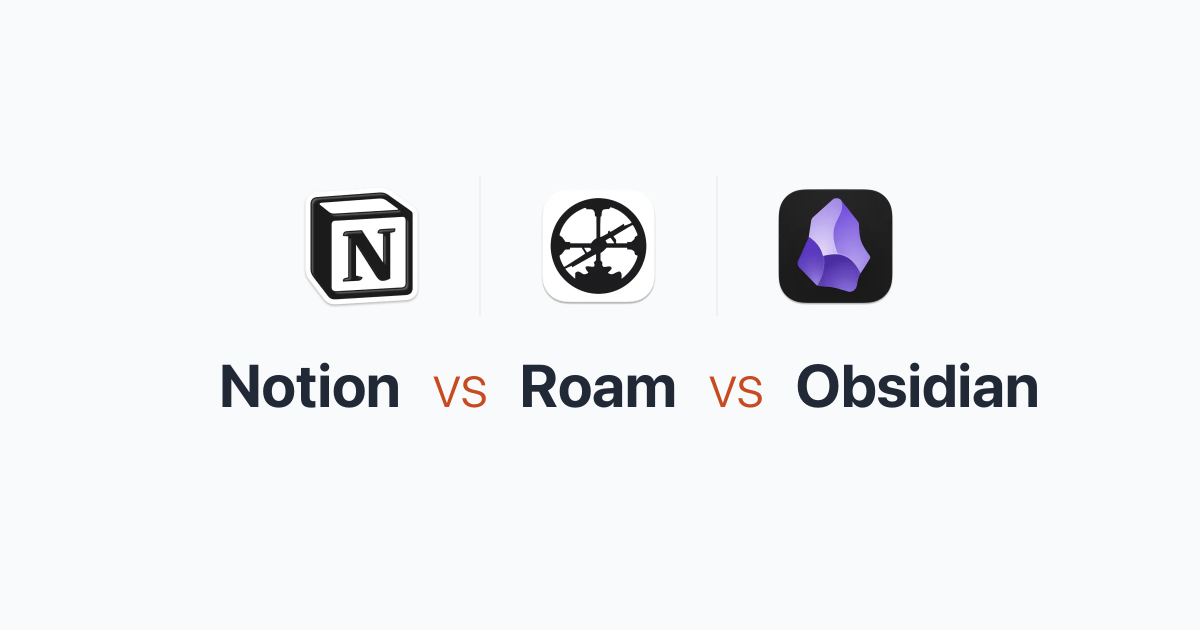
The personal knowledge management wars have settled into a stable three-way competition: Notion for collaborative, structured, database-driven work; Obsidian for personal, local-first, deeply networked thinking; and Roam Research for the researchers and writers who need a tool built around the way ideas actually connect. The right choice depends almost entirely on how you think, not on feature checklists.
Notion is the team tool. Its database features — the ability to view the same content as a table, a kanban board, a calendar, or a gallery — have no real equivalent in the other products, and the collaborative editing and sharing features make it the natural choice for teams. Notion AI is now integrated throughout the product. The weakness is that Notion organises your thinking for you, structuring information into predefined schemas. If the way you think does not fit those schemas — if your ideas are associative rather than categorical — the structure works against you.
Obsidian is the local-first, privacy-maximising choice for users who want to own their data. Files are stored as plain text Markdown on your device, meaning they are portable, version-controllable, and readable without any application. The graph view — which visualises the connections between your notes — makes emergent relationships visible in ways that Notion cannot match. The plugin ecosystem is extraordinary; there is a community plugin for almost any workflow. The weakness is the learning curve: Obsidian rewards investment and punishes impatience.
Roam Research is the most opinionated of the three. Built around the idea that thinking happens in outlines and that connections between ideas should be bidirectional and automatic, it attracts researchers, academics, and heavy writers who find its model of thought genuinely revelatory. At $15 per month with no free tier, it is also the most expensive. The weakness is its insularity — Roam does not integrate well with other tools, has a small team, and a product development pace that frustrates users accustomed to faster-moving products.
Verdict: Teams building shared knowledge bases should use Notion. Individuals building personal knowledge systems who prioritise data ownership should use Obsidian. Researchers and writers who find bidirectional linking transformative should try Roam. The tools are different enough that trying all three before committing is worth the time — all three offer free trials.
Leave a Reply