






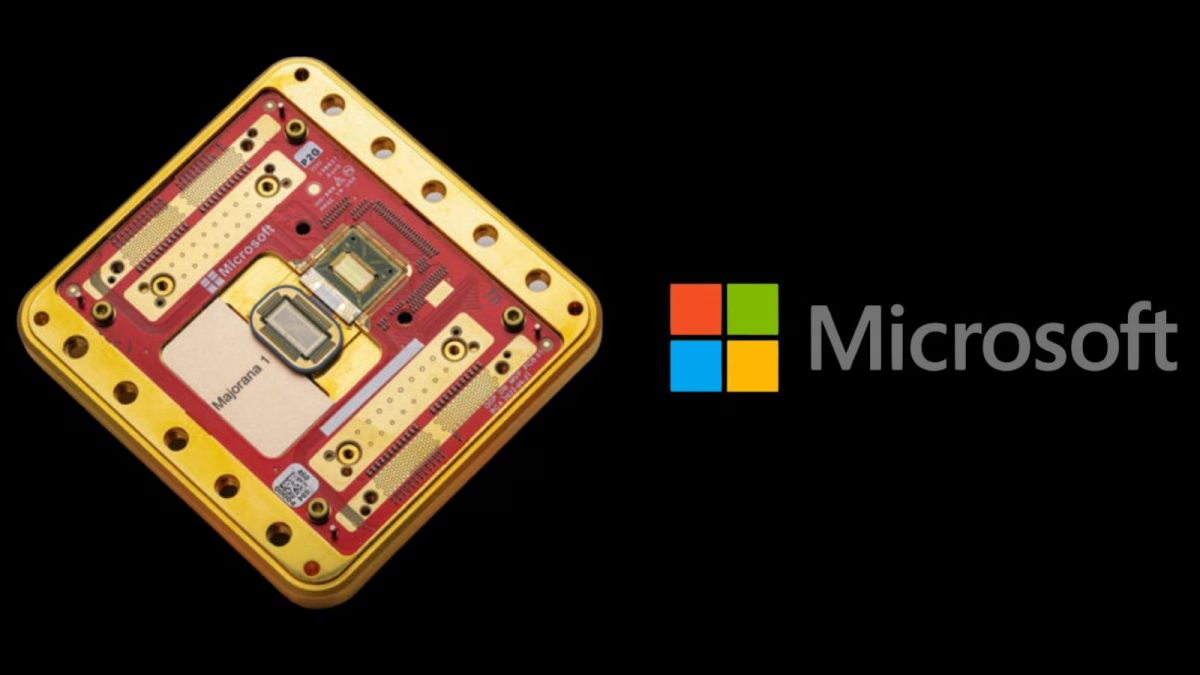
Quantum computing has been plagued for decades by a single stubborn problem: qubits are extraordinarily fragile. Any interaction with the environment — a stray electromagnetic field, a vibration, a photon — can destroy the quantum state that makes the computation possible. This is the decoherence problem, and it has kept quantum computers from becoming useful despite thirty years of effort.
Microsoft’s Majorana 1 chip, announced in February 2026, takes a fundamentally different approach to the problem. Rather than trying to isolate conventional qubits from their environment, Majorana 1 encodes information in a type of quantum particle — the Majorana fermion — that is inherently protected from certain classes of environmental disturbance by topology, a mathematical property of the particle’s structure.
“This is not an incremental improvement,” said Chetan Nayak, who leads Microsoft’s quantum hardware programme. “Topological qubits are a different architecture. If they work at scale, the error correction overhead that consumes most of the resources in conventional quantum computers simply does not apply.”
The chip contains eight topological qubits — far fewer than the hundreds or thousands in competing systems from IBM and Google. But Microsoft argues that the comparison is misleading: a single topological qubit, if the theory holds, is worth hundreds of conventional qubits once error correction overhead is factored in.
Independent researchers have been cautious. The Majorana fermion is a real phenomenon, but whether it can be reliably manufactured and controlled at scale remains an open question. Microsoft has been pursuing this approach for over a decade. What changed with Majorana 1 is that the company now has experimental data suggesting the approach can work — not just theoretical arguments that it should.
Leave a Reply